Smile and say “Hi”
Smile and say “Hi!”
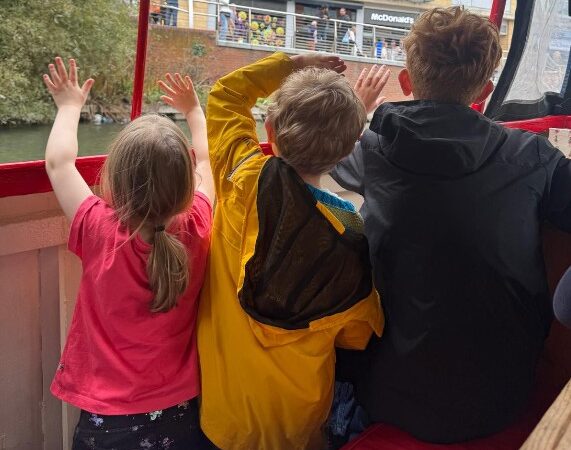
To celebrate my husband’s “significant birthday”, three generations of our family boarded a small boat just outside the Queens Road Car Park. We then travelled past the Oracle to Fobney Lock and back. It was a brilliant way to spend a warm, sunny afternoon.
During the journey, our grandchildren began waving and calling out “Hi!” to passing pedestrians, fisherman or cyclists on the bank. After looking slightly surprised, people smiled and waved back. As spectators were assembling at the Oracle for the annual duck race, almost a hundred people responded to our grandchildren that day.
Shortly afterwards, I was reminded of the story of Noah’s ark. Throughout our lifetimes, we will find ourselves travelling with a group of people in different “boats” that keep us safe and secure. These may include our families, friends, teams, communities, or even our nation. It’s a wonderful feeling to believe you have either grown up in an ark or been so fortunate on life’s journey to find one.
Our faith groups may also be compared to a boat ride. Within them we may find structure, security and the companionship of others on a similar journey. At times we may also wish to advertise all the advantages of belonging. This welcome assumes that others would be better off in our particular boat, as passengers or crew. It is absolutely sincere and may even visualise a desperate situation when others are drowning from misinformation or an inadequate way of life. Although these are acts of kindness and concern for others, I am not describing the process of interfaith.
Although most of our faith traditions teach something very specific about the way we should consider people of different faiths and backgrounds, it is sometimes overlooked through the satisfaction of being in the right boat. If you are motivated by all the personal benefits of belonging to a faith group, that identity may be likened to a mutual benefit society. It doesn’t seem very likely this should be the highest aspiration of any religious group I know.
Interfaith involves reaching out because we have faith not just in the worth of other people, but in separate identities too. This is how we become inclusive and develop trust among the diverse communities of reading.
Unfortunately, the world can be a very lonely place for a great many people. In recent years, some of the most unexpected people have become lonely through the mixed benefits of modern technology. Although it’s so much easier to work from home and often cheaper, it can lead to isolation. It’s now unusual to attend public meetings or social events in person, especially after dark or in winter. As we get older, names and faces often become harder to remember. Some of us have to focus on safety, mobility, not getting lost, or just the task in hand. It may also seem that we do not have sufficient confidence to meet other people,
Perhaps we want to help but are not quite sure how to go about it.?
When I was growing up, it was customary for adults to say “Good morning” or “Good Afternoon” to everyone they met. This was expected, so they never needed to think about how to start a conversation. If no one was in a hurry, there was then the shared experience of weather to say something about, however obvious it might seem. If you were lucky enough to support a football team or own a well-behaved dog, these were also readily available subjects to mention in passing. People went out to meet people because this was expected and almost invariably happened.
Even though our boat did get a bit noisy, it seems to me that often the most helpful thing we can do in a conflicted world is to maintain faith in our shared humanity, look out for other people, smile and say “Hi!”
Sarah Griffin