
The Story of Judith and Holoferness
The story of Judith and Holoferness
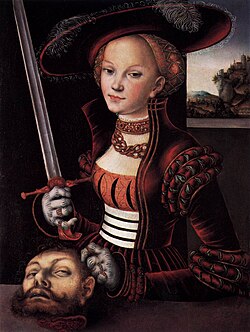
Judith does not appear in the main Cannon of either Judaism or Christianity, but remains a well-known and much illustrated story. There are many interpretations of the story from Vasari, Michelangelo, Rubens and one of course Caraveggio – which is particularly brutal. The one I like the best is by Lucas Crach painted in 1530.
So what is the interest?
For those of us named Judith, it is an essential story and whether or not it is true, it provides a fabulous example of a brave and courageous woman, fighting against an oppressive regime in ancient days. (What’s actually changed!).
According to Jewish tradition, the event took place during the Hasmonean Revolt in around 167 B.C.E ( before the common era as referred to in our writings.) The Assyrians had invaded Judea and had taken over the Holy Temple – desecrated it and there was the famous uprising led by Judah the Macabee, which gives rise to the festival of Hanukkah. Things were not going well and whilst the women and children were starving in the besieged cities around Jerusalem, the men were at war with the invaders.
Judith, whose husband had been killed in one of the battles, was living in the besieged city of Bethulia and decided that she had to do something to save her people. She was, according to tradition and the wonderful paintings (see above), a beautiful young woman. She had been noticed by the captain of the Assyrians who was starving out her city, although we are not told how or when!
In the event, she made some lovely food for this captain – traditionally made from cheese – and went into his camp with her maidservant, carrying it in a basket. What transpired, no one knows, but Holferness enjoyed his dinner and his wine so much that he fell asleep, before he had a chance to……..
Being a resourceful young woman, with the help of her maid-servant, she cut off his head using his own sword. She then packed it into her basket and returned to the city and placed the head on the ramparts of the walls – so that it could be seen both by those both inside and outside. The Assyrians saw that their general had been defeated and according to tradition – fled and the siege was lifted.
Judith became a heroine and an example to other women – there were other ways of fighting battles without going to war.
Shalom
Judi