Womens Speaking Justified
Womens Speaking Justified
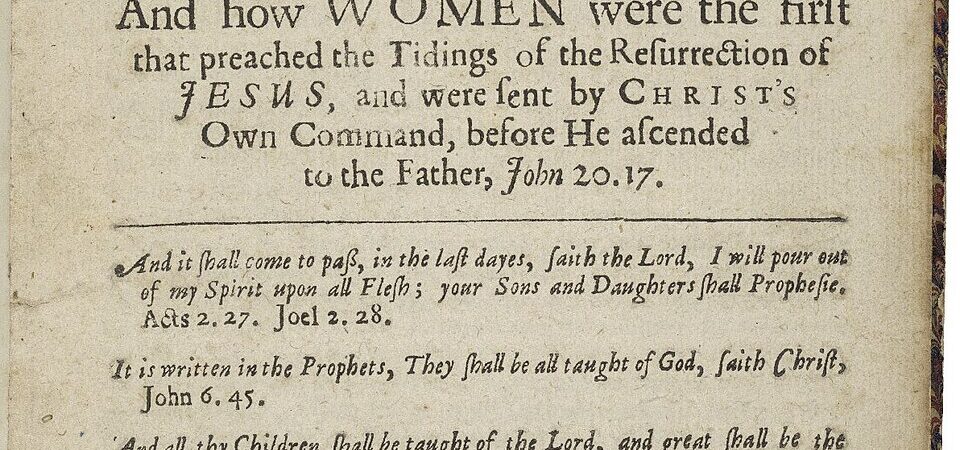
Margaret Fell had been in Lancaster prison for two years when she wrote Womens Speaking Justified by Scripture; (1666-67). She would remain there for two more -simply for having held a Quaker Meeting in her own home. Among her many writings this pamphlet particularly speaks to us today – in the year that the first ever female Archbishop of Canterbury has been appointed.
It is a work of passionate scholarship which predates modern Biblical analysis and feminist thinking – drawing upon her deep understanding of the Bible to show beyond doubt women’s equal standing as Christian ministers. It was women who first spoke with the risen Christ – and at first the men did not believe them. It was women who stayed close to Jesus on the cross, while the men watched from afar. Jesus and his disciples were funded in their mission by wealthy women. Margaret quotes the glorious ministry of women in the Old and New Testament, with an infectious relish and joy. She tackles the main Bible quotation used to silence women, with an awareness of historical context which is ground-breaking for the 17th century – when St Paul says that women should not speak in meetings, this is not a global ban but arises from the specific situation for new converts in Corinth at the time.
Margaret’s own life and work exemplify her argument. Margaret Askew (1614-1702) was first married to Thomas Fell, a judge and MP with great influence in the North of England. Her life was changed in June 1652 when the young Quaker founder George Fox spoke at their church in Ulverston – asking “what canst thou say…and that thou speakest, is it inwardly from God?”;. For Fox, Christian faith and practice comes from a first-hand encounter with the divine. He also often spoke out in favour of women as ministers and equal partners in faith.
Margaret was convinced, and turned her family home, Swarthmoor Hall, into the Quaker movement’s headquarters. Judge Fell deserves much credit for his wife’s role as ‘the Mother of Quakerism’-though never a Quaker, he respected Fox and shielded the movement from persecution. Like the women who funded the mission of Jesus, Margaret raised money to support travelling ministries and Quakers in prison. She used her status to petition King Charles II on the Quakers’ behalf. She did all this while raising seven Quaker daughters – and a son who did not join the movement. Eleven years after the death of Judge Fell, Margaret married George Fox in 1669. Despite many spells in prison, they worked in constant partnership until his death in 1691. Margaret remained active in the movement, during quieter times after persecution, until she died in 1702 aged 87. In her last decade she spoke out against a growing Quaker obsession with standards of dress, calling it;”a silly gospel;”. For her, the spirit always mattered much more than the letter – an example to the end of why women’s speaking is justified.
Izzy Brimelow